
SYBAU stands for “Shut Your B*tch A Up.”** That is the full, unambiguous meaning – confirmed by Merriam-Webster, Urban Dictionary, Wiktionary, and Know Your Meme.
It is a blunt, aggressive internet acronym used to tell someone to stop talking. Depending on who is saying it and to whom, it can read as playful banter between friends or a genuine hostile insult. The context, the platform, and the relationship between the people involved determine everything about how the term lands.
If you saw it online and had no idea what it meant – you are far from alone. The term has spread rapidly in 2024 and 2025, and a significant part of its viral appeal is that many adults still do not know its real meaning.
Table of Contents
- What Does SYBAU Stand For?
- How Is It Pronounced?
- The Origin Story: Where Did It Come From?
- How It Went Viral on TikTok
- The “Clean Meaning” Trick
- How the Acronym Is Used Online
- SYBAU vs STFU – What Is the Difference?
- When Is It Playful vs When Is It an Insult?
- Where You Will See It Online
- Should Parents Be Concerned?
- Frequently Asked Questions
- Conclusion
What Does SYBAU Stand For?
SYBAU is an initialism – each letter represents a word:
| Letter | Word |
| S | Shut |
| Y | Your |
| B | Bitch |
| A | Ass |
| U | Up |
It is an abbreviation for “shut your bitch ass up” – an angrier way to say “shut up” online. The term is vulgar by design. The profanity is the point – it elevates a simple dismissal into something sharper and more confrontational.
Some online users have attempted to reframe the acronym with a cleaner meaning – “Stay Young, Beautiful, And Unique” or “Stay Young, Beautiful, And Unstoppable” being the most widely circulated alternatives. These false meanings were invented by teenagers to mislead adults who asked what the term meant. The real meaning has never changed.
How Is It Pronounced?
Because the acronym is not a common English word, people have developed several ways to say it out loud. The most common pronunciations are “see-bow,” “sigh-bow,” and “sea-brow.” None of these is formally correct – they simply reflect how different communities have phonetically worked through the letters.
In written online communication, the term is almost always typed rather than spoken, so pronunciation varies widely even among frequent users.
The Origin Story: Where Did It Come From?
The acronym is older than most people assume. It has been used online since as early as 2003, when it was first defined on Urban Dictionary. The earliest known definition was submitted by an Urban Dictionary user on November 19, 2003 – meaning the term predates YouTube, Twitter, and TikTok entirely.
Evidence of the term dates back more than 20 years, sometimes used with tongue in cheek but usually with vituperation in the midst of online arguments.
For most of the 2000s and 2010s, the acronym remained a niche piece of internet vocabulary – known in certain online communities, particularly gaming and early forum culture, but never reaching mainstream attention. It existed in the background of the internet’s slang vocabulary for nearly two decades before its moment arrived.
How It Went Viral on TikTok
The term’s mainstream explosion came in late 2024 and 2025. It became increasingly popularized in the mid-2020s, particularly on TikTok, with virality peaking in late 2024 and early 2025.
Several factors drove the sudden resurgence:
Short-form video culture TikTok’s comment sections are fast, reactive, and reward sharp, compressed responses. A five-letter acronym that delivers maximum dismissal with minimum effort fits the platform’s communication style perfectly.
Content filter evasion Because it is an initialism, the term often slips past casual content filters and appears in comments or replies when emotions run high. Platforms that would block explicit language have a harder time catching acronyms, which contributed to its spread in spaces where direct profanity would be removed.
The “TS PMO ICL” video format The term is often used in TS PMO ICL videos – a TikTok format where creators react to things that irritate or frustrate them. The combination of complaint content and sharp dismissive language made the acronym a natural fixture in that genre.
The mystery element A significant driver of the term’s spread was that most adults had no idea what it meant – and teenagers knew it. That information gap became its own kind of entertainment. Videos of adults learning the real meaning, or of kids deliberately misleading parents with the “stay young, beautiful” version, racked up millions of views.
The “Clean Meaning” Trick
One of the most distinctive aspects of this term’s viral spread is the coordinated effort by younger users to hide its real meaning from adults.
In one TikTok video, an adult asked what the acronym truly means, and tweens flooded the comments with false answers. One user wrote it means “stay young, beautiful, and unique,” which became the most agreed-upon false response.
The situation escalated when the fake meaning began spreading so effectively that parents started using the term themselves – unknowingly repeating a vulgar insult while believing they were sharing an inspirational phrase. Teachers and parenting content creators eventually began making videos to warn adults about the true definition.
A teacher in one viral clip explained: “Your child is telling you to shut your b-word a-word up. Do with it whatever you will.”
This gap between what the term actually means and what adults were told it means became a significant part of the story – and generated its own wave of viral content.
How the Acronym Is Used Online
The term functions differently depending on context, platform, and relationship. Here are the main ways it appears:
As a direct comeback The most straightforward use – firing back at someone in an argument, a comment section, or a group chat. In this context it is genuinely hostile and intended to shut down conversation aggressively.
As ironic exaggeration In memes and jokes, it is sometimes employed ironically to exaggerate internet drama – used humorously to respond to something mildly annoying rather than genuinely offensive. The profanity adds theatrical weight to a reaction that is, underneath, more eye-roll than anger.
As friendly banter Among close friends with an established dynamic of teasing, the term can function as affectionate exasperation – the equivalent of saying “oh, stop it” but louder. Tone and emoji usage (💀😂😭) usually signal this register clearly.
As a reaction caption On TikTok, the term frequently appears as a text overlay or caption on reaction videos – the creator responding to something they find ridiculous, wrong, or irritating. In this context it is more performance than aggression.
SYBAU vs STFU – What Is the Difference?
Both acronyms tell someone to stop talking. But they are not identical.
| Feature | SYBAU | STFU |
| Full form | Shut Your B*tch A** Up | Shut The F**k Up |
| Age of term | 2003 | Late 1990s |
| Current popularity | Viral since 2024–25 | Long-established |
| Tone | Slangy, modern, sometimes ironic | More direct and aggressive |
| Platform association | TikTok, Discord, Gen Z spaces | Broad – all platforms |
| Known by adults | Often no | Usually yes |
| Use in banter | Common | Common |
The key practical difference is generational and contextual. STFU is widely understood across age groups and has been part of internet vocabulary for 25+ years. The newer term arrived later, carries a more specifically Gen Z flavor, and – until recently – had the advantage of being unknown to many adults.
When Is It Playful vs When Is It an Insult?
Context determines everything. The same five letters can mean completely different things:
Likely playful:
- Used between close friends with a history of roasting each other
- Accompanied by laughing or crying emojis (😂💀😭)
- Posted in a private group chat among people who know each other
- Used ironically in response to something mildly annoying
Likely hostile:
- Directed at a stranger in a public comment section
- Used without any softening emoji or tone marker
- Sent in response to genuine disagreement or conflict
- Used by someone with no existing relationship with the recipient
Genuinely harmful:
- Used repeatedly to silence or intimidate someone
- Directed at someone younger or in a position of less power
- Used in coordination with others to pile on a target
- Sent with the clear intent to humiliate rather than joke
Without context – who said it, to whom, and why – the term’s tone is easy to misread. Screenshots capture words, not tone, history, or intent.
Where You Will See It Online
The term appears across most major social platforms, but some more than others:
TikTok The primary platform for its current viral life. It appears in comment sections under debate videos and hot-take content, as text overlays on reaction videos, and in the TS PMO ICL video genre.
Twitter / X Particularly common during heated fan debates – Love Island USA discourse being one prominent example where the term appeared frequently in mid-2025.
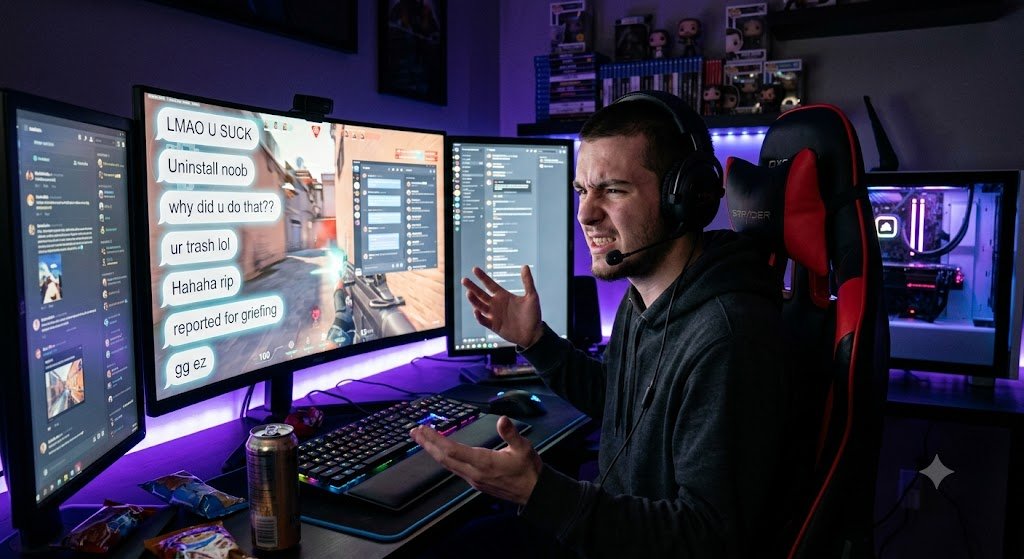
Discord and gaming Fast-paced conversations in gaming lobbies and Discord servers, particularly after losses, trash talk, or rule disputes. Online gaming has always had a rich vocabulary of sharp insults and dismissals, and this term fits naturally into that culture.
Snapchat Used in quick replies to private Snaps or group chats, especially when a joke goes too far or someone spams the chat.
Instagram Appears in meme comment sections and under Reels where people disagree or tease each other.
Schools and in-person use The acronym has crossed from online into physical spaces. Teenagers have been documented using it verbally at school and at home – including, in several viral cases, saying it directly to parents who did not know what it meant.
Should Parents Be Concerned?
This is a question many parents are actively searching for – and the honest answer is: it depends on how it is being used.
When it is probably fine: Teenagers using slang among close friends is normal, and some level of edge in peer communication has always existed. If the term is being used as banter with friends who share the same communication style, it is unlikely to be causing harm.
When it warrants a conversation: If a child is using the term to silence adults, dismiss teachers, or communicate with strangers online, that is worth addressing – not because the acronym itself is uniquely dangerous, but because the underlying communication pattern may need attention.
What experts suggest: Rather than reacting with alarm, parenting and education professionals generally recommend asking neutral questions – “Where did you hear this?” “How do you think someone might feel reading that?” – to open dialogue without triggering defensiveness. The goal is understanding context, not punishment for knowing a slang term.
The more significant concern raised by some commentators is not the term itself but the deliberate deception involved in spreading false meanings to adults. Teaching children that deceiving parents is a normal and funny thing to do is a pattern worth discussing.
Frequently Asked Questions
What does SYBAU mean?
SYBAU stands for “Shut Your B*tch A** Up.” It is a vulgar internet acronym used to tell someone to stop talking, with a tone that ranges from playful banter among friends to genuine hostility, depending on the context. The term is confirmed by Merriam-Webster, Wiktionary, Urban Dictionary, and Know Your Meme.
When did SYBAU originate?
The term has been documented online since at least 2003, when it first appeared on Urban Dictionary. Despite this long history, it remained relatively niche for most of its existence before going viral on TikTok in late 2024 and throughout 2025.
Does SYBAU mean “Stay Young, Beautiful, and Unique”?
No. This alternative meaning was deliberately invented and spread by teenagers to mislead adults who asked what the acronym meant. While “Stay Young, Beautiful, And Unique” (and similar variations) circulated widely on TikTok and other platforms, the real and only true meaning is “Shut Your B*tch A** Up.”
How is SYBAU pronounced?
There is no single official pronunciation. The most commonly used versions are “see-bow,” “sigh-bow,” and “sea-brow.” Because the acronym is primarily used in written online communication, pronunciation varies widely between communities.
What is the difference between SYBAU and STFU?
Both acronyms are used to tell someone to be quiet. STFU (“Shut The F**k Up”) is the older and more widely recognized term, in use since the late 1990s and understood across generations. The newer term is more specifically associated with Gen Z internet culture, particularly TikTok, and carries a slightly more slangy and sometimes ironic tone compared to the more direct STFU.
Is SYBAU offensive?
Yes – the term is inherently vulgar, containing explicit profanity. Its level of offensiveness in any specific situation depends on context, relationship, tone, and platform. Among close friends, using it as banter, it may feel harmless. Directed at a stranger, a teacher, or a parent, it is a genuine insult. Anyone using the term should be aware of how it may be received by the person they are addressing.
Conclusion
SYBAU means “Shut Your B*tch A** Up.” That has always been the meaning, going back to 2003 when it first appeared on Urban Dictionary, and no amount of viral misinformation about inspirational phrases changes that.
What makes the term genuinely interesting as a piece of internet language is not the insult itself – blunt dismissals have existed in every human language since the beginning – but the mechanics of how it spread. An old acronym was rediscovered, a coordinated false meaning was invented to confuse adults, the confusion itself went viral, and millions of people learned what the term meant by watching videos of other people finding out.
That process – slang as in-group code, viral spread, adult confusion, public reveal – is a distinctly internet-era phenomenon. And it is a reminder that understanding what people are saying online often requires knowing not just what words mean, but what they are doing.
Published by WordNest Editorial Team